Physicochemical and Thermal Analysis of Silane-Modified Carbonated Hydroxyapatite Fillers for Periodontal Application
DOI:
https://doi.org/10.11113/humentech.v5n2.148Keywords:
Periodontal disease, Carbonated hydroxyapatite, Silanization, Periodontal applicationAbstract
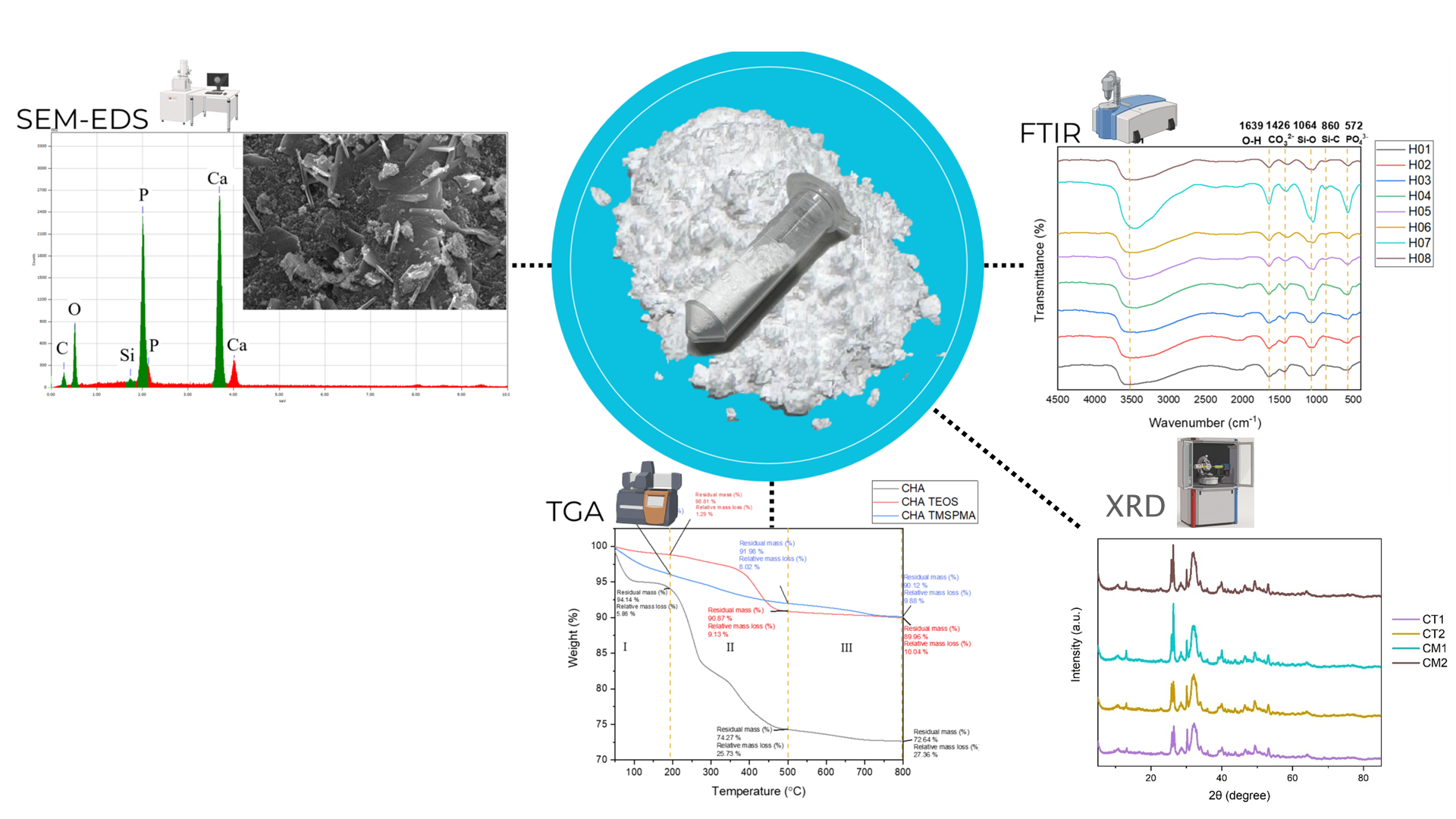
Periodontal disease is a chronic inflammation affecting the teeth’s supporting structures that, if untreated, can lead to tooth loss. To address this issue, biomaterial-based approaches are currently being explored, requiring materials that are biocompatible and capable of supporting bone regeneration. Carbonated hydroxyapatite (CHA) has shown promise for periodontal applications due to its biocompatibility and enhanced bioactivity compared to stoichiometric hydroxyapatite. However, surface modification of CHA is necessary to improve its performance as a filler in composite biomaterials. To address this, two silane coupling agents, tetraethyl orthosilicate (TEOS) and 3-(trimethoxysilyl)propyl methacrylate (TMSPMA) were evaluated at different reaction temperatures. Physicochemical and thermal analyses were conducted to determine the optimal strategy for modifying the CHA surface. The physicochemical analyses confirmed successful carbonation and silanization of CHA, with higher reaction temperatures yielding more extensive and homogeneous silane condensation on the surface. The elemental analysis revealed that the CHA modified with TEOS at 78.3°C possessed the highest silicon content among all groups. Furthermore, silanization process enhanced the thermal stability of CHA. Thus, silanization at elevated temperatures has effectively modified the CHA matrix, with TEOS modification at 78.3°C identified as the optimal strategy for periodontal biomaterial applications.